Updates
Spotlight!
FDA Celebrates Black History Month!
Alma LeVant Hayden's Contribution to Regulatory Science
A remarkable but unsung leader, Alma LeVant Hayden played a pivotal role in advancing FDA's drug analysis capabilities in the 1950s and 1960s. An expert in spectrophotometry and chromatography, she helped to implement these techniques in FDA's drug review and enforcement work, modernizing the agency's scientific techniques at a critical time in the agency's growth and amidst revolutionary changes in federal drug regulation.
Consumer Updates
Don’t Overuse Acetaminophen

You have flu symptoms, so you’ve been getting some relief by taking a cough and flu medicine every few hours. Late in the day, you have a headache and think about grabbing a couple of acetaminophen tablets (Tylenol, paracetamol and panadol) to treat the pain. Stop right there.
Guidance Documents
Collection of Race and Ethnicity Data in Clinical Trials and Clinical Studies for FDA-Regulated Medical Products
The purpose of this guidance is to provide FDA’s expectations for, and recommendations on, use of a standardized approach for collecting and reporting race and ethnicity data in submissions including information collected and reported from clinical studies and clinical trials for FDA-regulated medical products.
Considerations for the Development of Chimeric Antigen Receptor (CAR) T Cell Products
This guidance is intended to assist sponsors, including industry and academic sponsors, developing CAR T cell products. In this guidance, we, FDA, provide CAR T cell specific recommendations regarding chemistry, manufacturing, and control (CMC), pharmacology and toxicology, and clinical study design.
Human Gene Therapy Products Incorporating Human Genome Editing
In this guidance, we, FDA, are providing recommendations to sponsors developing human gene therapy products incorporating genome editing (GE) of human somatic cells. Specifically, this guidance provides recommendations regarding information that should be provided in an Investigational New Drug (IND) application in order to assess the safety and quality of the investigational GE product, as required in Title 21 of the Code of Federal Regulations 312.23 (21 CFR 312.23).
View all Official FDA Guidance Documents and other Regulatory Guidance
You can search for documents using key words, and you can narrow or filter your results by product, date issued, FDA organizational unit, type of document, subject, draft or final status, and comment period.
ICYMI!
10 Facts about What FDA Does and Does Not Approve
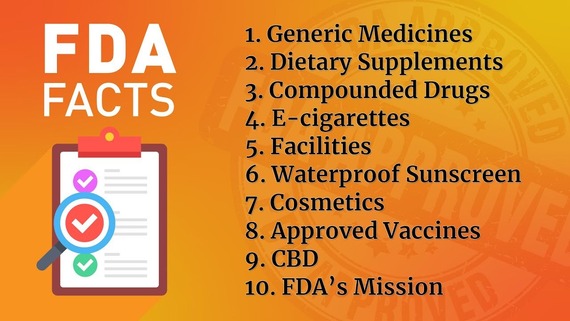
Is It Really "FDA Approved"? Maybe you’ve seen these words on a company’s website or in a commercial promoting a product or treatment. Here are some facts about products that are, and aren’t, FDA approved.
Fact #1: Generic medicines work the same as brand-name medicines.
FDA-approved generic medicines provide the same clinical benefit and risks as their brand-name counterparts. A generic medicine is required to be the same as a brand-name medicine in dosage, safety, effectiveness, strength, stability, quality, and administration.
Fact #2: Vitamins, minerals, herbs, and other dietary supplements are NOT FDA-approved to treat or prevent disease.
If a supplement promises a cure or quick fix for a health problem, it may be too good to be true.
Webinars and Virtual Workshops
FDA Rare Disease Day 2024
March 1, 2024; 9 a.m. - 4:30 p.m. ET

This year’s Rare Disease Day is dedicated to patients and health care professionals. Panels will discuss:
- The legal framework for approving studies and medical products at FDA
- What FDA does during review processes to approve medical products
- Decentralized clinical trials and digital health technologies
- Where to find important information and documents related to clinical trials
- Information that can be obtained from medical product labels
- Legal and ethical requirements for consent forms in clinical trials
- FDA initiatives to advance medical product development for rare diseases
- Ways for patients to engage with FDA
Advancing the Use of Complex Innovative Designs in Clinical Trials: From Pilot to Practice
March 5, 2024; 9 a.m. - 3:30 p.m. ET
This meeting is being conducted to meet the performance goal of convening a public workshop on complex innovative design (CID) included in the seventh authorization of the Prescription Drug User Fee Act (PDUFA VII).
The purpose of this public workshop is to facilitate discussion on the use of external data sources, Bayesian statistical methods, and simulations in complex innovative trial designs as well as trial implementation.
Integrated Safety Analyses in Drug Marketing Applications: Avoiding Common Mistakes
March 7, 2024; 1 - 2:30 p.m. ET
This webinar will discuss how and when to work with FDA to improve your integrated safety analyses and obtain answers to questions you may have about your application. In addition, common mistakes seen in integrated analyses will be discussed to help you avoid making the same mistakes.
FDA CBER Webinar: Considerations for the Development of CAR T Cell Products
March 7, 2024; 1 - 2 p.m. ET
The FDA Center for Biologics Evaluation and Research (CBER) Office of Therapeutic Products (OTP) is hosting a virtual public webinar to discuss a recently finalized guidance document on considerations for the development of Chimeric Antigen Receptor (CAR) T cell products. This guidance is intended to assist industry and academic sponsors that are developing ex vivo-manufactured CAR T cell products.
View Upcoming FDA Meetings, Conferences and Workshops
Public meetings involving the FDA: Upcoming events, past meetings, meeting materials, and transcripts
About Us
The Stakeholder Engagement Staff resides within the Office of the Commissioner and falls under the Office of External Affairs. We aim to build stronger relationships with health professional organizations, consumer groups, trade associations, patient advocacy organizations, think tanks/academia, and other stakeholders, in order to better inform our policy making process, identify policy hurdles or stakeholder misconceptions, and create strategic collaborations. For more information, please contact us at: FDAStakeholderEngagement@fda.hhs.gov.
|




.tmb-rotator.png?Culture=en&sfvrsn=e3185440_1)